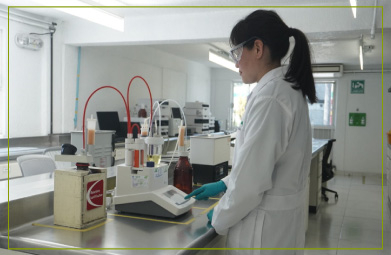
Identification, quantification and purity of active ingredients in pesticides, technical materials (TC) and technical concentrates (TK)

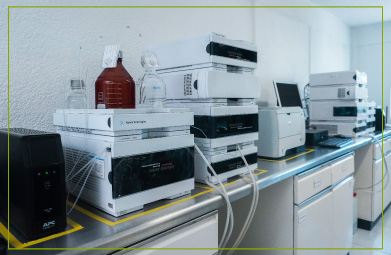
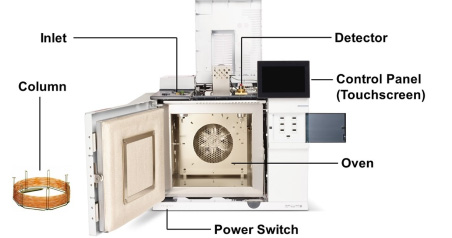
Gas Chromatography coupled to Mass Spectrometry (GC/MS)
LEARN MORE

  • Most recommended method to separate and analyze volatile organic compounds (boiling point < 250ÂșC).
  • Most widely applied chromatographic technique and with greater versatility in the analysis of environmental pollutants.
  • TCD detectors for analysis of inorganic gasses and FID detector for identification of unknown organic components in mixtures and quantification of concentration or purity.
  • With a library of more than 10,000 identifiable compounds

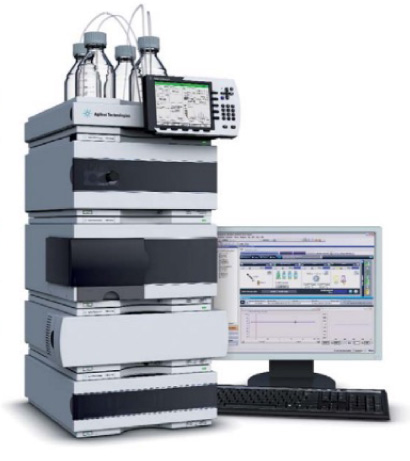
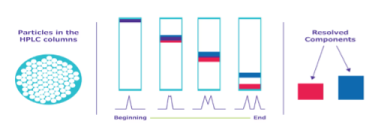
Ultra High Performance Liquid Chromatography (UHPLC)

LEARN MORE

  • Its application is highly occupied in non-volatile and thermally unstable organic compounds.
  • Diode Array Detector (link) The continuous beam of light passes through the cell. The radiation is then resolved into its constituent wavelengths which are individually detected by the diode array.
  • Higher chromatographic resolution in complex mixtures.
  • Higher sensitivity in mixtures with low analyte concentrations.
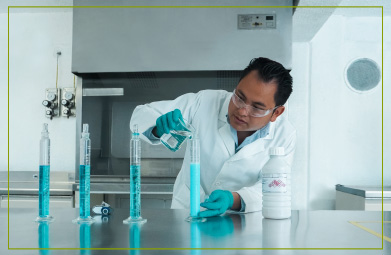
Tests related to the use of pesticides
carried out under CIPAC methodologies.

Simple liquid solutions

LEARN MORE

Concentrated suspensions (SC)

  • Suspensibility
  • Spontaneity of dispersion
  • Wet retention
  • Persistence to foam
  • Particle size distribution
  • Viscosity

Soluble concentrates (SL)

  • Persistence to foam
  • Solution stability

Emulsifiable concentrates (EC)

  • Foam persistence
  • Emulsification and re-emulsification

Solid formulations for direct use

LEARN MORE

Dry powders (DP) and granules (GR)

  • Water content by Karl Fischer
  • Granulometry

Solid formulations for dispersion
LEARN MORE

Wettable powders (WP) and water dispersible granules (WG)

  • Wettability
  • Suspensibility
  • Persistent foam
  • Wet retention
  • Water content by Karl Fischer
  • Particle size distribution